Workplace Happiness Isn’t Comfort: What Truly Makes Teams Happy

Last week marked the International Day of Happiness, and as these kinds of awareness days roll around, I often see conversations about what happiness at work looks like. The images that tend to accompany those conversations are fairly predictable: smiling teams around a table tennis table, offices filled with free snacks, or teams celebrating another “fun culture” moment together.
While those things can certainly be enjoyable, they’ve never really captured what happiness at work means to me. In fact, some of those environments have had the opposite effect on me.
For a long time, the tech industry has pushed the idea that happy teams are comfortable teams. The assumption seems to be that if people are relaxed, entertained, and surrounded by perks, they will naturally feel fulfilled and motivated. But my experience has been very different.
Happiness at work is not about comfort. It is about being challenged in an environment that still feels safe and supportive.
If we are not challenged, we get bored. This is especially true in fields like engineering, where curiosity and problem-solving are often the very reasons people chose the work in the first place. The goal should never be to remove difficulty from work. Instead, the goal should be to create an environment where people feel safe enough to engage with difficult problems.
That environment usually includes a few key ingredients: clear goals, psychological safety, and leaders who remain calm when things become complicated. When those pieces are in place, pressure can become energising instead of overwhelming. Teams push themselves, debate ideas, and experiment more freely because they know that mistakes will not immediately turn into blame.
I once worked on a project where the timeline was extremely short and I had to produce something I had never built before. The pressure was real and the work was intense. But the difference was that expectations were clear and I had the support of managers who made it clear that they had my back if something went wrong. Because of that, the pressure felt productive rather than frightening. Everyone stayed calm, the team collaborated closely, and the final result was something we were incredibly proud of.
That is what I think of as productive tension.
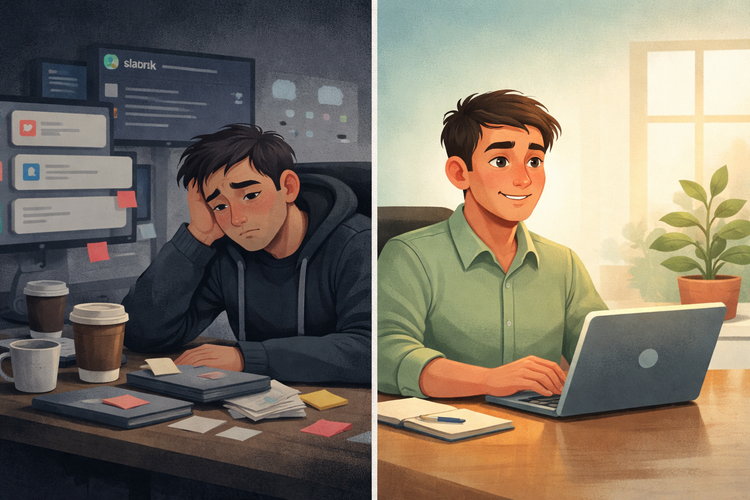
Unfortunately, I have also experienced the opposite kind of environment far too many times. In those situations, the workplace is stuck in a permanent state of urgency. Everything is treated as a crisis and there is never enough time to recover between problems. Instead of stepping back to address the root causes of the stress — unrealistic timelines, unclear requirements, or poor processes — organisations simply continue reacting to the next emergency.
When teams operate like this for long enough, urgency eventually turns into blame. Developers are told they were too slow. Teams are accused of misrepresenting timelines. Scope creep is accepted in the name of keeping a client happy, and then the delivery team is blamed when the impossible inevitably becomes impossible.
Over time, environments like this erode trust and drain creativity. People stop experimenting and taking initiative because it feels safer to protect themselves than to try something new. Instead of building great products together, everyone is simply trying to survive the next crisis.
That kind of pressure is not productive tension. It is toxic stress.
Another common misconception about happy teams is that everyone always agrees with one another. Some leaders believe that a harmonious team is one where conflict rarely appears. In reality, healthy teams disagree frequently. Engineers debate architecture decisions, designers push for better user experiences, and product managers challenge timelines and priorities.
Disagreement is not the problem. In fact, it is often a sign that people care deeply about the work.
What matters is whether the environment allows for safe disagreement. When people can challenge ideas without attacking each other personally, those conversations tend to sharpen thinking and lead to better outcomes. Silence may feel peaceful in the moment, but it rarely produces the best solutions.
One of the biggest lessons I have learned as a leader is that teams often borrow their emotional state from the people leading them. When leaders panic, teams panic. When leaders blame individuals, teams begin hiding mistakes. But when leaders remain calm and steady, teams are far more likely to focus on solving problems instead of protecting themselves.
When something goes wrong — and in software something eventually always does — my goal is to stay calm. Shouting or reacting emotionally might release frustration in the moment, but it does not solve the problem any faster. In fact, it usually makes things worse because people become anxious and less willing to communicate openly.
Instead, the focus should be on creating an action plan and solving the issue as quickly as possible. Once the situation is stable again, that is when the real conversation happens. Not to find someone to blame, but to understand why the problem occurred and what we can learn from it.
Mistakes will always happen. The important part is what teams choose to do afterward.
Another element of happiness at work is meaningful work, although what feels meaningful can differ widely from person to person. Some engineers are motivated by solving complex technical problems. Others are energised by seeing the real-world impact their work has on users. Some thrive on learning new technologies, while others value the collaborative experience of building something together as a team.
For me personally, the most fulfilling moments come from solving interesting problems and seeing the impact those solutions have on real people using the product. When those elements are present, work becomes energising rather than draining.
Looking back, the happiest teams I have worked with were not necessarily the ones with the most visible perks or the loudest celebrations. Their happiness was much quieter and more steady. Those teams had clarity about their goals, trust between colleagues, and the freedom to grow and learn together.
The result was not constant excitement or entertainment. Instead, it was something far more sustainable: steady progress and a sense of shared purpose.
Real workplace happiness is not about removing challenges or avoiding pressure altogether. It is about creating an environment where people feel supported while tackling meaningful problems. It is about allowing space for debate, creativity, and learning without turning every mistake into a source of blame.
When teams are given that kind of environment, something powerful tends to happen. People grow. Teams improve. And the work itself becomes better.
We learn, we adapt, and we come out smarter.