The Hidden Work of AI: Checking, Correcting and Making the Final Decision
I was using AI to help with a rebuild in Flutter when I noticed something had started to drift. The implementation still looked like progress. Code was being written, files were appearing and the feature was taking shape. But it was no longer following the instructions I had given it closely enough.
Some of the code had been added to the wrong folders. Other decisions had begun to deviate from the structure I wanted. None of it was necessarily dramatic on its own, but together it meant the job was not finished when the AI said it was finished. I still needed to inspect what had been built, understand why it had taken that route and correct the parts that did not belong.
Then came another layer of work. Once I understood where it had gone wrong, I added clearer instructions to the documentation and introduced more guard rails. I was not only correcting the implementation. I was also improving the environment around the AI so that it would be less likely to make the same mistake again.
AI had saved me time. Then it asked for some of that time back.
This is the part of working with AI that can disappear inside the promise of productivity. We see how quickly it can produce an answer, generate code or explain a system. We do not always count the time spent prompting, checking, comparing, correcting and deciding whether the answer understands the actual problem.
The output is fast. Knowing whether it is right is still work.
A Polished Answer Can Still Be the Wrong Answer
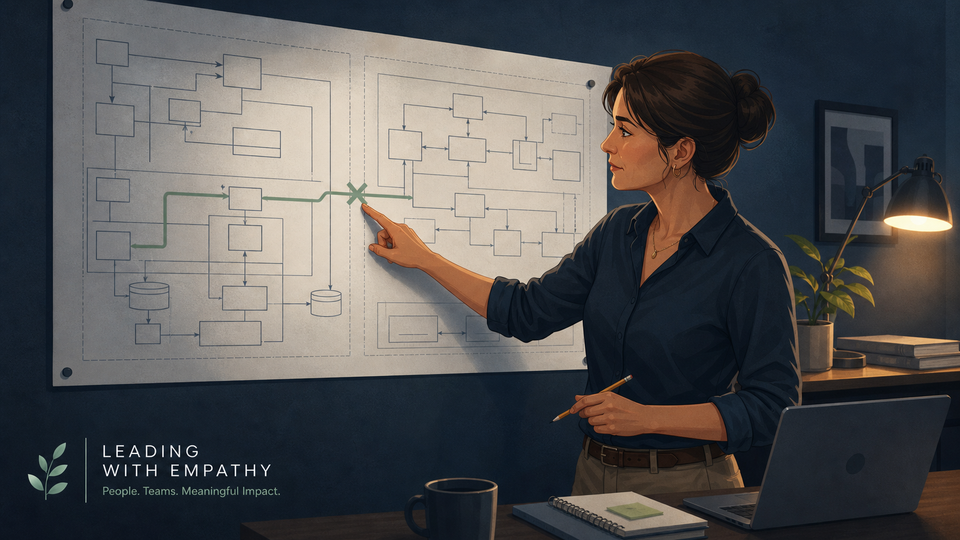
I experienced a simpler, slightly funnier version of this while creating a diagram for some code that needed to be refactored. The AI already had context about where we wanted the system to go eventually. What I needed in that moment, though, was a diagram of what the system was doing now.
Instead, it went on its own little road trip.
It produced a diagram that included the future refactor. The result was polished and technically plausible. It even reflected information I had previously given it. It simply answered a different question from the one I was asking.
That distinction matters. A clean diagram is not useful if it combines the current system with the proposed system and makes it harder to see the very problems we are trying to understand. The issue was not that the AI lacked context. In a strange way, it had too much context and chose the wrong part of it to prioritise.
This is one of the risks of judging AI by the quality of its presentation. An answer can be clear, detailed and confidently expressed while still misunderstanding the need underneath the request. Sometimes the error is obvious. Sometimes it is hidden inside something that looks convincing enough to accept.
That is why reviewing AI output involves more than checking whether it compiles or whether the explanation sounds sensible. We also have to ask whether it solved the problem we actually had.
The Hidden Work Begins After the Answer Appears
Checking an AI answer is not a quick glance followed by approval. To review it properly, I need to read what it produced and understand it. I need to compare the result with the instructions, the codebase and the intended outcome. If it took a direction I do not understand, I need to keep asking questions until I know why.
Only then can I decide whether the decision is acceptable or needs to change.
Correcting the problem can take even longer. A misplaced file can reveal that an architectural boundary was never written down clearly. An incorrect assumption can show that the documentation leaves room for several interpretations. Fixing the immediate output solves today’s problem, but preventing the same mistake tomorrow may require better instructions, clearer documentation or another guard rail.
This work is valuable. It makes both the codebase and future AI-assisted work more predictable. But it is still work, and it needs to be included in any honest conversation about the time AI saves.
Without that acknowledgement, the human contribution becomes strangely invisible. The AI appears to have implemented the feature in minutes, while the person reviewing it spends far longer making sure those minutes produced something the team can safely maintain.
Speed Depends on What You Already Know
I trust an AI answer when I have read it, understood it and decided that it makes sense. I always inspect it.
That sounds simple, but it exposes an important limit. To assess an answer, someone still needs enough knowledge to recognise what is correct, what is suspicious and what needs further investigation. AI can provide information quickly, but it cannot remove the need for judgement from the person using that information.
Sometimes the AI’s explanation helps build the knowledge required to review its work. If I do not understand why it chose a particular approach, I can ask it to explain the reasoning, trace the dependencies or compare the alternatives. That conversation can be extremely useful. It can also become part of the hidden workload, especially when the first confident answer turns out not to reflect the real system.
The skill is no longer only knowing how to produce the work yourself. It is also knowing how to question what has been produced for you.
That requires technical understanding, context and the willingness to slow down when an answer looks almost right. In many cases, “almost right” is where the most careful thinking begins.
The Time Saving Is Still Real
None of this means AI does not save time. It has saved me an enormous amount of time when working with legacy codebases.
Understanding an unfamiliar system used to mean spending days tracing how one part connected to another. With AI, I can ask it to explain a code path or create a diagram, and receive a useful starting point within seconds. I can explore the system conversationally, ask follow-up questions and reach a working understanding much faster.
That is a meaningful improvement. It gives me more time to think about the decisions that need to be made rather than spending all of it collecting the basic context.
But the example of the refactoring diagram is a useful reminder that even this strength needs oversight. AI can trace the system quickly, but I still need to be precise about whether I am asking for the current state, the future state or a comparison between the two. I also need to check that the diagram reflects what the code actually does.
The value is not in accepting whatever appears first. The value is in shortening the distance between a difficult question and an informed human decision.
AI Changes the Work More Than It Removes It
When organisations treat AI adoption as an automatic productivity gain, they can overlook the work that moves rather than disappears.
Writing the first version may become faster. Reviewing becomes more important. Finding information may become easier. Verifying it becomes essential. Producing options may take seconds. Choosing the right one still depends on someone understanding the consequences.
This is also why the idea that AI will simply replace people feels incomplete. People are still needed to understand the information it provides, recognise when it has misunderstood the situation and implement or correct changes responsibly. Even when AI performs a large portion of the visible task, a person remains responsible for deciding whether the result belongs in the real world.
That responsibility cannot be measured only by how quickly the first answer arrived.
Perhaps the most important capability AI is strengthening is not prompting. It is judgement. The ability to look past a polished response, notice that something is slightly off and keep asking questions until the answer meets the actual need.
AI can make us faster, but speed is only useful when we know where we are going. Otherwise, we may discover that the answer has taken its own little road trip, and we are the ones who still have to bring it home.

Member discussion