Leadership Burnout Is Real: You Can’t Lead Well If You’re Running on Empty
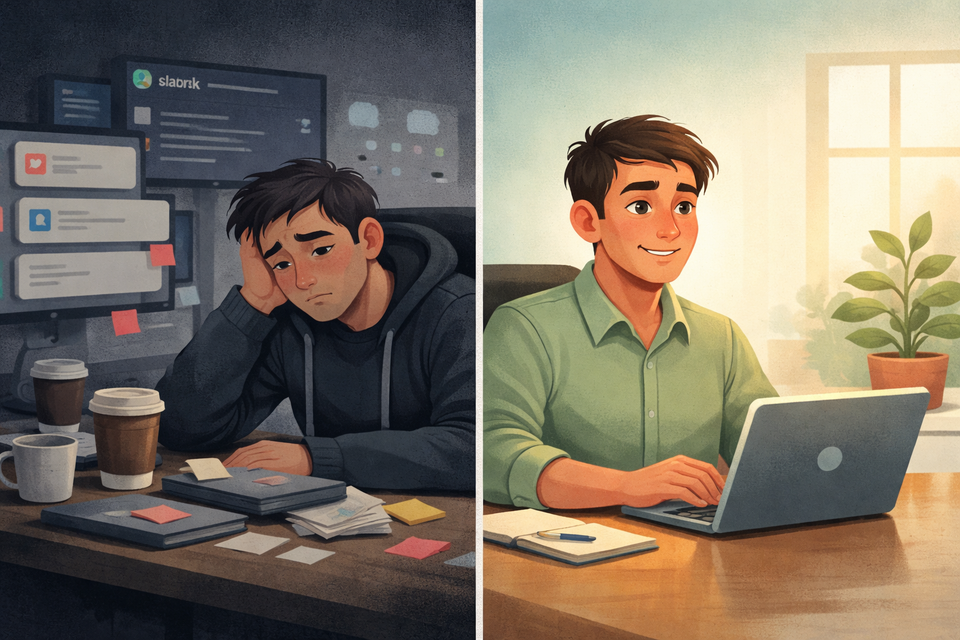
There was a point where my calendar was constantly full, my Slack notifications never stopped, and yet I was still expected to be fully present for my team. I was juggling multiple projects, sitting in back-to-back meetings, and keeping an eye on different Slack channels to make sure nothing slipped through the cracks. At the same time, I carried the responsibility of supporting my team, making sure they felt safe and heard, and showing up as the positive, steady presence people could rely on during company interactions.
On paper, it all sounds manageable. In reality, it was exhausting.
What I didn’t fully appreciate at the time was that leadership isn’t just about output. It’s not only about delivering results, unblocking work, or ensuring deadlines are met. Leadership is deeply emotional work. It requires presence, patience, and clarity. And those are the very things that start to fade when you’re running on empty.
For me, the shift didn’t happen overnight. It crept in slowly. I became less engaged in meetings and noticeably less chatty. My patience wore thin, and I started avoiding conversations that I would normally have leaned into. Decision-making, which used to feel natural, became heavy and overwhelming. Eventually, I found myself making poor decisions simply because I didn’t have the mental capacity to properly think things through. Decision fatigue is real, and when you’re leading a team, the consequences extend far beyond yourself.
The moment it truly clicked for me was when things started to fall apart. Projects weren’t running as smoothly as they once had, communication felt strained, and there was a growing sense of friction within the work. My initial instinct was to look outward and try to identify what was going wrong. But the uncomfortable truth was that nothing external had suddenly broken. I had.
I was doing the work of three people across multiple projects, trying to hold everything together at once. There was no sustainable version of that situation. Of course things were slipping. Of course the quality was dropping. I was stretched far beyond what any one person could reasonably carry.
One of the most important lessons I’ve learned through this is that your team always knows when something is off. Even if they don’t say it out loud, they feel the shift. The energy changes, the clarity isn’t the same, and the small moments of connection begin to disappear. People respond to that environment in different ways. Some step up and take ownership, showing initiative and growth. Others quietly disengage, doing the minimum required and pulling back. Neither response is random; both are reflections of the environment they are operating in.
There is a version of leadership that encourages pushing through at all costs. It tells you to be resilient, to hold everything together, and to keep going no matter what. I tried that approach, and it didn’t work for me. There were times where I genuinely tried to change the system around me, to reduce friction and create a more sustainable way of working. In many cases, I failed, not because the ideas were wrong, but because the broader structure wasn’t willing to change.
Eventually, I had to make a decision, not just as a leader, but as a person. I chose to leave environments that were breaking me. It wasn’t an easy decision, but staying was costing too much, both mentally and physically. There was a point where I was so exhausted that I stopped taking care of myself entirely. I was eating poorly, not moving my body, and simply trying to get through each day. That wasn’t leadership anymore; it was survival.
Taking care of myself didn’t come from one big, dramatic change. It came from a series of smaller, intentional decisions. I moved into a role where I could make a meaningful impact, where there was less friction between leadership layers and more opportunity to build both strong processes and great technology. I started writing more, using it as a way to reflect and learn from my experiences. I focused on my physical well-being again, eating properly, exercising, and reconnecting with activities I love, like gardening, cooking, and baking.
These changes may seem simple, but they helped me reconnect with myself. And when that happened, everything about how I showed up as a leader improved.
I still hold high standards for myself and my team. That hasn’t changed. What has changed is how I approach those standards. I now focus on setting realistic goals, ensuring my team has the information they need to succeed, and creating an environment where we can do meaningful work without burning ourselves out in the process. We aim for excellence, but not at the expense of our well-being.
If there is one thing I hope you take away from this, it’s this: you have to look after yourself first. Not in a selfish way, but in a sustainable one. Because the truth is, you cannot lead a team effectively if you are quietly falling apart behind the scenes.
Your presence, your energy, and your ability to think clearly are not “nice-to-haves” in leadership, they are the foundation of it. When those start to fade, no amount of extra effort can truly make up for their absence.
So if you are feeling constantly stretched, exhausted, or like you are just getting through each day, don’t brush it off as just a busy season. That feeling is trying to tell you something. It’s a signal that something needs to change.
And the sooner you choose to listen to it, the sooner you can return to leading in a way that is not only effective, but sustainable for both you and your team.